The AI co-scientist for
drug development.

Structured programs that generate novel hypotheses and de novo candidates, and return reviewable, evidence-backed artifacts with every claim traced to its source.

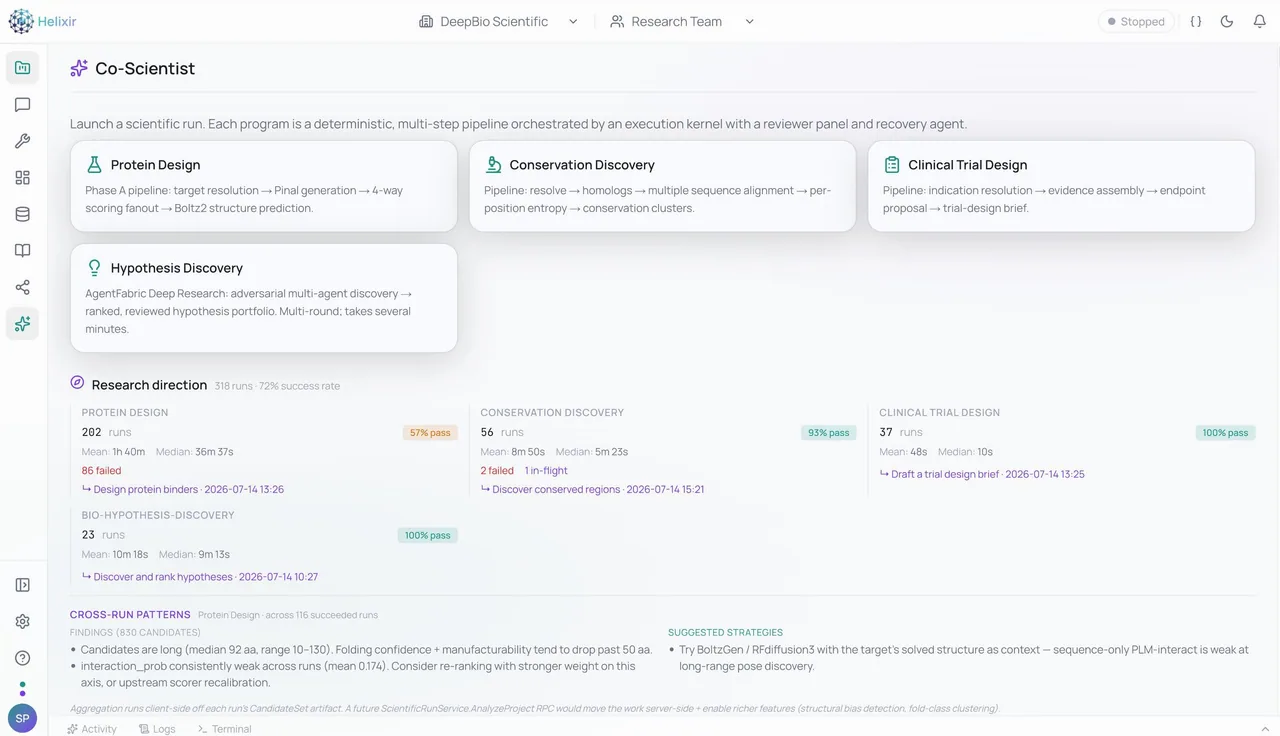
The Helixir Co-Scientist, with a program run open

A co-scientist for
hypothesis discovery.

Helixirhelixir.deepbioscientific.com/co-scientist/hypothesesillustrative run
Hypothesis Portfolio grounded illustrative workflow

Question: Does dual blockade of IL-23R and TYK2 produce superior mucosal healing versus IL-23R blockade alone in moderate-to-severe Crohn's disease?

hypotheses: 5 rounds: 4 top hypothesis: most supported stop: consensus_reached

Prioritize a head-to-head ex vivo mucosal biopsy assay (H1) before committing to the combination arm: it is the cheapest experiment that can falsify the additive-healing hypothesis within 6 weeks.

#1 Combined IL-23R + TYK2 inhibition additively suppresses Th17-driven mucosal inflammation beyond either agent alone. corroborated · 4 conf 82%

Next test: Ex vivo mucosal biopsy cytokine panel comparing mono- vs dual-inhibition.

IL-23 binds→ IL-23R · IL-23R signals via→ JAK2 / TYK2 · TYK2 drives→ STAT3-P · STAT3-P induces→ IL-17A / IL-22

Source Finding Stance Strength
Sands et al., N Engl J Med 2022 Risankizumab (anti-IL-23) induced clinical remission in 45% at wk12 supports 0.78
Danese et al., Lancet 2023 Deucravacitinib (TYK2i) reduced UC endoscopic score vs placebo supports 0.71
Feagan et al., Gastroenterology 2021 IL-23 blockade alone leaves residual TYK2–STAT3 signaling in ~30% of biopsies supports 0.64
Verstockt et al., Gut 2023 No additive benefit in a small combination cohort (n=18) contradicts 0.42

Caveats

  • Additivity shown in murine colitis may not translate to human mucosa (severity if false: high)
  • Combination may raise infection risk above monotherapy threshold (severity if false: moderate)

Proposed experiments

  1. Ex vivo mucosal biopsy cytokine panel comparing mono- vs dual-inhibition (falsifier: no reduction in IL-17A below monotherapy at 72h)
  2. Phase 1b safety run-in for combination dosing (falsifier: ≥grade-3 infection incidence >5%)

Derived from H0 (IL-23 axis) after red-team round 2 flagged residual TYK2 signaling.

#2 TYK2 P1104A loss-of-function carriers show intrinsically lower baseline mucosal IL-17A, predicting reduced combination benefit. corroborated · 2 conf 74%

Next test: Stratify the biopsy cohort by TYK2 P1104A genotype and compare IL-17A suppression.

Spun out of H1 during belief-update after peer-review flagged a genotype confounder.

#3 Combination therapy shifts the mucosal microbiome toward Faecalibacterium prausnitzii enrichment, contributing to durable remission. novel conf 61%

Next test: Shotgun metagenomics on paired pre/post biopsies from the combination arm.

Novel branch proposed by the scientist agent in round 3; no cited evidence attached yet.

#4 Serum IL-22 at week 4 is a non-invasive surrogate for endoscopic response to dual blockade. corroborated · 1 conf 55%

Next test: Correlate week-4 serum IL-22 with week-12 SES-CD in the run-in cohort.

Biomarker sub-hypothesis; single supporting reference, flagged low-power.

#5 Dual blockade risks compensatory upregulation of the IL-12 / IFN-γ (Th1) axis, blunting long-term efficacy. novel conf 47%

Next test: Measure mucosal IFN-γ and T-bet+ cell frequency after 8 weeks of dual therapy.

Red-team counter-hypothesis raised in round 4; retained for monitoring.

Novel results, reviewable artifacts: every claim traced to source evidence.

The window shows an illustrative workflow, not a verified result.

Programs
Request access
Grounded in evidence

Every answer stays connected to its sources.

Search and review the literature, and navigate a living knowledge graph of entities, claims and evidence: the surfaces the co-scientist reasons over, and traces every recommendation back to.

HelixirLiteratureillustrative
Target Literature pubmed+europepmc 34 papers · 6 tool calls illustrative workflow
mechanism 4
  • example sourceN Engl J Med

    Risankizumab induction and maintenance therapy in Crohn's disease

    Selective IL-23 p19 blockade produced significantly higher rates of clinical remission and endoscopic response than placebo across two induction trials, confirming the IL-23 axis as a driver of mucosal inflammation.

  • example sourceNature

    Structural basis of interleukin-23 recognition by its receptor

    Cryo-EM of the IL-23–IL-23R complex reveals the p19 helix-D interface that governs receptor engagement and downstream JAK2 / TYK2 recruitment, defining a druggable binding epitope.

  • example sourceImmunity

    IL-23R signaling licenses pathogenic Th17 cells in the gut

    Conditional deletion of IL-23R abrogated IL-17A / IL-22 production and protected mice against T-cell transfer colitis, establishing receptor signaling as necessary for the pathogenic Th17 program.

  • example sourceGastroenterology

    Residual TYK2–STAT3 signaling after IL-23 blockade in inflamed mucosa

    Roughly one third of mucosal biopsies retained phospho-STAT3 despite complete IL-23 neutralization, implicating a parallel TYK2-dependent pathway that may limit monotherapy efficacy.

known binders 3
  • example sourcemAbs

    Engineering risankizumab, a high-affinity anti–IL-23 p19 antibody

    Affinity maturation produced a Fab binding IL-23 p19 with sub-nanomolar KD and complete neutralization of receptor-mediated STAT3 activation in reporter assays.

  • example sourceJ Immunol

    Epitope mapping of guselkumab on the IL-23 p19 subunit

    Hydrogen–deuterium exchange localizes the guselkumab epitope to a surface distinct from the receptor interface, supporting an allosteric mechanism of neutralization.

  • example sourceNat Commun

    A designed miniprotein antagonist of the IL-23 receptor

    A computationally designed 74-residue mini-binder competes with IL-23 for IL-23R with low-nanomolar affinity and blocks Th17 differentiation in vitro.

disease association 3
  • example sourceScience

    A genome-wide association study identifies IL23R as an IBD susceptibility gene

    The IL23R R381Q variant confers strong protection against Crohn's disease, providing human genetic validation of the IL-23 pathway as a therapeutic target.

  • example sourceNat Genet

    Fine-mapping of IBD loci implicates coding variation in IL23R and TYK2

    Statistical fine-mapping resolves independent protective alleles across IL23R and TYK2, suggesting the two genes act in a shared pathway relevant to combination targeting.

  • example sourceGut

    Mucosal IL23R expression predicts response to anti-IL-23 therapy

    Baseline IL23R transcript levels in colonic biopsies stratified endoscopic responders from non-responders, motivating a biomarker-enriched trial design.

safety 2
  • example sourceLancet Gastroenterol Hepatol

    Long-term safety of IL-23 inhibitors in inflammatory bowel disease

    Pooled safety across three trials showed no increased serious-infection signal versus placebo through 52 weeks, supporting a favorable benefit–risk profile.

  • example sourceClin Gastroenterol Hepatol

    TYK2 inhibition and herpes zoster risk: a pharmacovigilance analysis

    Selective TYK2 inhibitors carried a modest, dose-dependent zoster signal, informing the safety monitoring plan for a combination regimen.

Reviewer hint: Mechanistic support is strong (cryo-EM plus human genetics), but head-to-head human combination data remains limited to a single underpowered cohort. Flag that as the key evidence gap.

HelixirKnowledge Graphlive
Knowledge Graph 14 nodes · 15 edges
Drag nodes · hover to trace · scroll to zoom
Now live: the graph behind every recommendation →
The Scientific Harness

An AI co-scientist that reasons over connected evidence.

Literature, biological relationships, project evidence and computational artifacts converge into one connected record: traceable evidence, explicit uncertainty, and scientist review.

Explore the model
Select any component to see how it feeds the harness, from raw sources through reasoning to reviewable results.

Connected scientific record

Links literature, biological relationships, project evidence and computational artifacts into one representation the Co-Scientists reason across.

Explicit uncertainty

Predicted properties are shown with their limitations and the evidence behind them, for a scientist to review rather than accept.

AI review agents

Generated candidates are red-teamed and reviewed by separate AI agents that force the tradeoffs into the open. Disagreement is preserved, not resolved away.

Full provenance

Every prediction traces back to source data, so wet-lab and regulatory teams can audit the reasoning behind it. Negative and inconclusive findings are preserved.

How you work with it
Selected

Chat

The front door: ask research questions in plain language, reference your project's context, and launch deeper work.

Selected

Canvas

A visual workspace for assembling repeatable research workflows from tool nodes, agent nodes, and notes.

Selected
encode
design
score
validate

Co-Scientist

Launch structured runs (hypothesis discovery, protein design, trial design) that return reviewable, evidence-backed artifacts.

Selected
foldblastassaycodonmatchcite

Tools

Agents, tools, skills and MCP servers: specialized scientific actions, callable by you or by an agent.

judge

Knowledge Graph

Explore entities, relationships, claims and evidence across a project, and trace every claim back to its source.

Five surfaces, one connected workspace.

However you work, whether chatting, sketching on Canvas, or running the Co-Scientist, every result stays connected and traced to source.

Request access →


See what the co-scientist designs for your target.

Request access
Capabilities

Everything the co-scientist does, on the record.

A recommendation traced by leader lines down to its cited evidence
Provenance

Every claim traces to source

No recommendation ships without an auditable path back to the evidence it rests on.

Specialist agents in a ring exchanging over a central judge
Rigor

AI review agents that argue

Generated candidates are red-teamed, reviewed and ranked by separate agents. Methods differ by program; disagreement is treated as signal, not defect.

A biological knowledge graph of entities, claims and evidence
Context

A living knowledge graph

Entities, claims, and evidence linked per project: a queryable substrate, not flat document storage.

A stack of reviewable research dossiers
Output

Reviewable artifacts, not opaque answers

Long-running programs return exportable artifacts a scientist can inspect, question, and reuse, with pause and resume across a run.

A calibration curve over a faint grid
Uncertainty

Evidence and limitations, available for review

Every score arrives with the method and the reasoning attached, and with what it does not establish stated alongside it.

Process

From research question to wet-lab-ready candidate.

The co-scientist runs every stage up to the wet lab, and shows its work at each step.

01

Encode the biology

The equivariant foundation model represents the target in the same geometric language as the molecule, capturing structure, not just sequence.

02

Design candidates

Generative models propose candidates and iterate, while AI review agents force the tradeoffs between predicted expression, stability, and immunogenicity into the open.

03

Assess predicted properties and uncertainty

Each candidate is scored on model-specific predicted endpoints, each labelled as a prediction and shown with the evidence and limitations behind it.

04

Hand off with provenance

Every recommendation is traced to source data, with the next verification step named, so wet-lab and regulatory teams can audit the reasoning before anything is tested. Designs can then move to our wet-lab collaboration at the University of Central Florida for experimental follow-up.

The output
Structure, not just sequence
mRNA · designed strandEvery recommendation traced to source data
Pricing

Two ways to work with Helixir

Early access for research teams assessing Helixir on their own work, custom programs for pharma and biotech partners who need dedicated support.

Researchers & biotech teams

Early access

Run hypothesis discovery, protein design, and literature review on your own work, with program availability confirmed when your early-access account is set up.

By request
  • Access to the Co-Scientist programs open in early access
  • Structured runs with reviewable, evidence-backed artifacts
  • Research use; scientist review required
Apply for early access
Pharma & biotech

Custom programs

Custom design programs built around your pipeline, with a dedicated support team and milestone-based engagement.

Per-program + milestone
  • Custom-scoped Co-Scientist programs
  • Dedicated support team
  • Milestone-based engagement
Request a demo
Every program ships with full provenance: every recommendation traces to its evidence, and clinical trial designs require expert review.